

Coaching is the stance that comes online last (and most Scrum Masters under-use it)
Article content
Article sections
The lesson that engagement eventually taught me, and the one I now spend most of the CSP-SM class circling back to, has two parts. Coaching is the stance most Scrum Masters develop last, because the stances below it on the curve are easier defaults to fall into and learning to coach means earning the right to stop reaching for them. And the second part took me longer to see: coaching the team is the peak you climb toward, but a coaching mindset is supposed to be running underneath every stance the whole way up. When I jumped straight to powerful questions with a novice team, I had the mindset but not the stance — I was respecting their autonomy to figure it out while quietly asking them to manufacture experience they did not yet have. They were perfectly capable of inventing a sprint from first principles. The inventing just took eight weeks they did not have to spare.
The five stances, and the one mindset under all of them
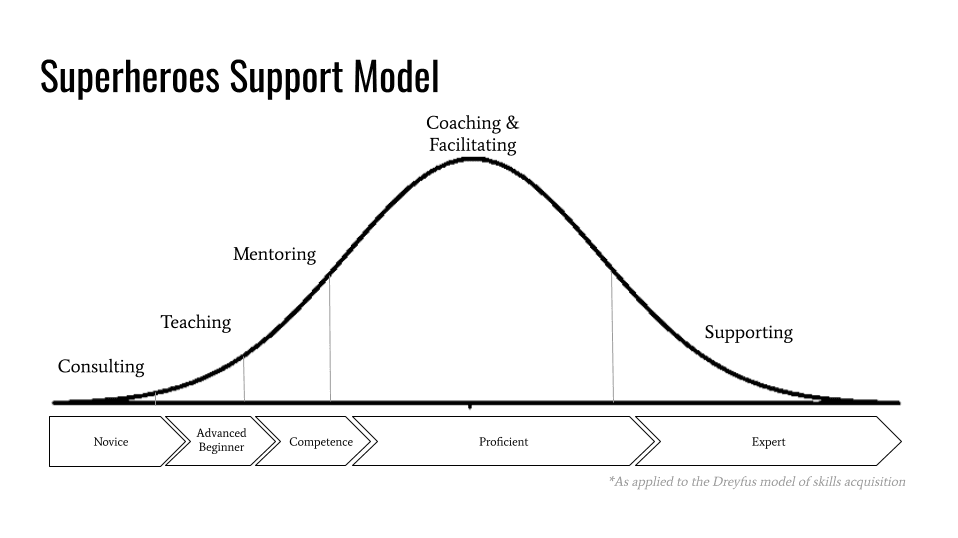
The model I teach now is the one we call the Superheroes Support Model. It takes the five ways a Scrum Master can support a team and lays them out along the team's growth from novice to expert. Reading left to right, they are consulting, teaching, mentoring, coaching, and supporting. If you came up through the certification track you will recognise most of these as the classic Scrum Master stances, with two deliberate moves: facilitating rides along with coaching at the top of the curve, because by then the team mostly needs a clean container rather than content, and supporting is named as its own stance at the far end because the work you do with an expert team is real even though it looks like almost nothing.
The mindset under all five. Every one of these stances is delivered through a coaching mindset, which for me means one specific, non-negotiable thing: the team keeps the right to make its own decision. When I consult a novice I do not hand them the answer; I lay out two or three options and genuinely respect whichever one they pick. The stance changes as the team grows. The respect for their autonomy never does. That is the thread that makes this a coaching model rather than a maturity ladder you graduate the team along.
Most Scrum Masters spend the first couple of years on the job leaning hard on whichever one or two stances they brought into the role, and gradually picking up the rest from the curriculum. The coaching stance, coaching in the ICF sense of partnering with a client through a thought-provoking process, almost always comes last. That is not because it is held back from you. It is because it is the hardest to do without slipping down into one of the stances below it, and the only way to learn it is to deploy it badly a few times and notice that you did.
Why coaching comes online last
The reason coaching sits at the top of the curve is mechanical rather than aspirational, and it is worth saying out loud because the word "advanced" carries the wrong implication. The stances on the way up are all about putting something into the team. When you consult, you put options on the table so a team with nothing yet has something to choose between. When you teach, you transfer the theory the team is missing, and their working model becomes a copy of yours until they have had enough reps to build their own. When you mentor, you share what you have lived through, and the team gets to borrow your experience without having to bleed for it first. Each of those adds something the team does not yet have. Coaching is the move you make once the team already has it, both the knowledge and the experience, and the only thing left to add is their own thinking, drawn out rather than put in.
That is why you have to earn it. Coaching is the only stance where the team's wheel stays entirely the team's wheel. You ask questions that help them think, but you do not put your own answer next to theirs for them to choose between, because by now they do not need yours. Done well, coaching produces decisions the team owns and can repeat without you in the room. Done badly, coaching looks like what I was doing in 2014: powerful questions to a team that had not yet learned what a sprint planning even was, hoping they would invent it themselves from first principles.
Coaching is based on the premise that people are creative, resourceful and whole and already have everything they need to move forward in their lives.International Coach Federation, on the coaching premise
That premise is exactly right, and it has one footnote the ICF definition leaves to the practitioner. The phrase already have everything they need assumes a starting capability. With a novice team the resources are not yet in the room, which means coaching them in that state is asking the room to manufacture experience it does not yet have. The fix is not to abandon the coaching premise. It is to honour the premise with your mindset, the part that respects their autonomy, while meeting them with the stance their skill level can actually use today, which for a novice is a clear set of options and the freedom to pick one.
The Support Model, stage by stage
The whole model is a small adaptation of the Dreyfus Model of Skill Acquisition. Read the team's skill level on the topic in front of you, every meeting, and pick the stance that matches the level. The stance you offer climbs the curve as the team climbs the Dreyfus stages.
-
Novice → Consult
There is nothing they know yet, so there is nothing for them to invent. Don't make them. Lay out the options the way an experienced colleague would: "here are two or three ways teams handle this, and here is the trade-off in each." Then, and this is the coaching-mindset part, you genuinely respect whichever one they choose. You are not deciding for them. You are making sure they have something real to decide between, because a novice asked to choose from an empty table will just stall.
-
Advanced beginner → Teach
The team has started doing the work and has discovered they are missing the theory underneath it. Now teaching lands, because they have the hooks to hang it on. Teach what the Sprint is for, what the Definition of Done is doing, how the events connect, using the same vocabulary the certification class taught you. The team needs the shared words before it can have the harder conversation, and a team with a little experience is hungry for the framework in a way a true novice is not yet.
-
Competent → Mentor
The team knows the rules now, but it does not yet have a feel for which ones to bend and which to hold tight. This is where you tell stories. "Here's how I watched a team very like yours handle exactly this." "Here's the version of this that bit me once." You are letting them learn from your experience instead of buying the whole lesson at full price, and because it arrives as a story rather than an instruction, their choice stays their choice.
-
Proficient → Coach (and facilitate)
This is the top of the curve, and it is the flip. The team has been practising long enough that they now hold both the knowledge you taught them and the experience you mentored them through. They have what they need. So you stop putting things in and start drawing things out: the powerful question, the held silence, the clean container you facilitate so their own thinking has somewhere to go. This is where coaching finally lands, because the room has the resources to act on the answer it generates. It is also where most of us writing about coaching want to start, and where we have to remind ourselves that we do not get to.
-
Expert → Support
The team is past needing you to develop them on this skill, and the temptation is to vanish entirely. Don't, quite. Supporting is the lightest stance and a real one: you catch them doing the thing well and you name it, you point out the growth they are too close to see, you stay available without inserting yourself. It looks like almost nothing, and it is the stance that tells a strong team it is not being abandoned the moment it stops needing to be carried.
The real skill is reading the room every meeting, on every topic, and noticing that the team's level can be three different things in the same standup. Estimation may be at novice while conflict-handling is at expert and product-discovery is somewhere around competent. The model is not a label you stick on the team; it is a label for the topic in front of you in that specific moment. Brock writes about the instinct underneath all of this from a different angle in The Coaching Mindset, and the two posts are companion pieces on the same idea.
How I actually run this with a team
The part that surprises people is that I do not keep the model to myself and quietly pick a stance behind the scenes. I put it on the wall. Making the choice visible is what turns it from something I am doing to the team into something we are doing together, and it is the single move that has done the most to make my support land.
- Show them the curve. I walk the team through all five stances and the Dreyfus stages underneath them, so the language is shared. Five minutes, once.
- Ask them to self-assess. Pick a specific skill, not the whole team's maturity. "On estimation, where would you put yourselves on this curve?" Teams are usually more honest about this than I would have guessed, and the conversation alone is worth the meeting.
- Ask what support they want from me. Once they have placed themselves, I ask the question that should have been obvious all along: "given that, what do you want from me here, consulting, teaching, mentoring, coaching, or supporting?" Sometimes their answer is not the stance I would have picked, and that is useful information about a gap between how I read them and how they read themselves.
This is the whole model running through a coaching mindset, all the way down to the choice of stance itself. And because you run it at the level of a single skill, "working yourself out of a job" stops being a frightening idea. You do work yourself out of a job on estimation, and the moment you do, the team is ready to be developed on something else. There is always a next skill, and the team is almost always sitting at a different stage on each one.
What changes when you read stances
Two things, both visible inside a single sprint, are usually the first signs the practice has clicked. The first is that your standups get noticeably shorter. When you match the stance to the topic and the team's level on that topic, the room moves, decisions land, and the meeting ends earlier than expected. When you do not match, the room negotiates the meta-question of whose role it is to answer the question, and that negotiation eats time without producing anything. Teams that have been together a year and still run forty-five-minute standups are almost always being coached by someone who should have dropped back to consulting six months ago, or taught at by someone who should have been mentoring.
The second thing is more subjective and matters more in the long run. You stop feeling like you are doing the job wrong. The most common pattern in our CSP-SM cohort is a thoughtful Scrum Master who senses they are not in the right stance and cannot name which one they should be in. The Support Model does not make you right in the moment, but it makes the question askable, which is the precondition for getting better at it. Our companion piece Hey coaches, sometimes you just need to consult goes deeper on the specific case of resisting the coaching-only reflex when the team needs an answer.
What to do this week
Pick one specific moment from your last team interaction. Not a whole meeting, just a moment. A standup question that fell flat, a retro thread that did not go anywhere, a planning conversation that wandered. Ask yourself which of the five stances you were in for that moment, and then ask which one would have fit the team's skill level on that topic in that moment. If those two are the same, you read the room well. If they are different, the gap is the practice. Most of us find, the first time we run this exercise, that we were coaching when the moment wanted consulting, or consulting when the team had already moved past us. Both are useful to notice, and neither one means you are failing. It just means the stance is now a choice instead of a reflex, which is the whole game.
The five stances are a palette, not a ladder. Coaching is the most advanced not because it is morally superior to the other four but because it is the hardest to deploy without infringing on the team, and it requires the team to be ready to be partnered with rather than developed. The deeper skill, the one that takes years and that I am still working on, is reading ready, on this skill, this week. That is the move that separates the practitioner who coaches well from the one who coaches by reflex.
If you want a second pair of eyes on your stance defaults, write back when the welcome email lands. The replies reach Erkan and Brock directly. Most of what surfaces in those conversations is the gap between the stance someone thinks they are using and the one their team is actually experiencing. If you are newer to the role and the Support Model is the first time this idea has landed, our Coaching Sprint methodology is a structured way to spend ninety days closing one stance gap at a time, and the related What's in a question piece from Brock is a good companion if you want to sit with the question-as-tool a little longer before you act on the map.